Showing posts with label Conclave Archive. Show all posts

Saturday, 27 February 2016

Conclave of Har Archive: BLOWING YOUR MIND, THE ART OF AIRBRUSHING

Airbrushing is all the rage these days. It has long been the preserve of proper artists whether they work in two or three dimensions but accessibility has increased as the price of a good quality set up comes down and a wealth of tutorials for hobbyists who want to try their hand at airbrush techniques can be found on YouTube. For a novice there is a lot to take in and a lot you need to know before you throw down a wad of cash on a rig and get started. Here I share my experiences.

I have vague memories of simple airbrushing in primary school. A metal tube was used to blow paint onto a piece of paper and create unusual effects. The cardinal rule was do not inhale! As an adult this advice still serves, but we’ll get to that.

It was Forge World who popularised the technique for me. Those expertly painted tanks and monstrous kits achieving effects that we as hobbyists could never seem to emulate with regular brushes alone no matter how hard we tried. How many ‘Eavy Metal vehicles were in fact painted using air brushes? My own experience with airbrushes is still basic and ongoing but I am making progress and if what I have learned thus far can help you avoid the few stumbling missteps I have made on my journey then I have achieved something! I will go into each of these in more detail in future articles but for now here is an overview of what you need to know.


The Theory

An airbrush works by atomising paint using compressed air to create a vacuum which draws the paint into the airstream for delivery. The amount of pressure required depends on how thick the paint is. The thicker the paint the more pressure required. If you are using an airbrush for fine miniature work you will be working with pressures between 10-50 psi.

An experienced and talented airbrush operator can blend one or more colours almost seamlessly without the need for blending or feathering and also much more quickly. If you want to be able to do more than just basecoat your miniatures then these are the effects you will need to learn.

The Airbrush

Airbrushing done correctly requires the right sort of kit. The starting point is the airbrush itself. I am not talking about the super basic kit such as the Games Workshop hand flamer spray gun. Whilst this is good for base coating especially large areas such as terrain with the right modifications it is not a precision airbrush.

There are a number of different types of airbrush but the best is a dual action trigger airbrush. This allows for the greatest measure of control over the application of paint. By pressing down on the trigger you release the airflow and by pulling back on the trigger you release the paint. The amount of paint you release is determined by how far back you pull the trigger.


The Compressor

A large part of the control you have over the paint will come from the airflow. Although you can purchase cans of propellant for airbrushes these are next to useless. You cannot create a smooth consistent stream of paint with what is essentially an aerosol can. In order to get that strong, smooth and consistent flow of air you require a compressor.

This is a pump that pushes the air through the airbrush at pressure. They tend to be loud and get hot but they are essential. The best kind of compressor has an auxiliary storagetank which stores air under pressure that can be bled off when needed. This has the advantage of not requiring the compressor to be running all the time and allows you to have a ready air flow available all the time that does not require you to wait for the pump to run up to speed.

Attached to your compressor should be a moisture trap. This sucks the excess moisture from the air that is comprising your air flow. Excess moisture can change the consistency of your paint which if already thinned could make it too runny or even clog up your airbrush with water droplets.

Lastly should be the pressure gauge which will allow you to change the pressure the air that flows through your brush is under. For finer layers you will want to work with lower psi, 10-20psi, for larger areas or for thicker layers you will require higher psi, 40-50psi


Maintenance

An airbrush is a precision instrument made up of many components. In order to keep it in good running order you need to take care of it. To do this there are a number of tools and you will need.

The first stop is some airbrush cleaner and a pipette. The pipette will make handling the airbrush cleaner much easier as generally this comes in bottles and trying to tip this solution into your reservoir can get messy. Every time you have finished using a particular paint you should clean your airbrush thoroughly. Paint that dries inside your airbrush can restrict the flow of air and paint as well as contaminate your colours if they are different enough. This also means you should try and get through using the colour you are on quickly to reduce the time this has to happen.

If you are unfortunate enough to find dried paint in your airbrush you will need to dismantle it for a thorough clean. Small brushes will be invaluable if this is the case. More delicate work can be done using a Q-tip soaked in cleaner. (Q-tip is an American term for Cotton Bud - Al)

Safety

Atomised paint and airbrush cleaner can cause extensive damage to your lungs if inhaled. You should never hold the airbrush or model you are painting close to your face when working. Work in a well-ventilated area and if using lacquer paints always use a facemask. Also be aware that compressors can get very hot even if on for only a short time. Do not pick up or touch your compressor until it has had a chance to cool down.


Paint

Thinning paints is a pain. Some paints such as lacquers need to be thinned in order to use but with acrylics there are several range of paints that have been specially formulated to be used straight from the bottle such as Vallejo’s Model Air range or Badger’s Minitaire. I have recently started using both and already I have noticed an improvement in my ability to manipulate the paint and in the amount of time it takes to clean the brush after use.

Right now I am still at the basing stage but some brief trials of the air brush formula paints has given me the confidence to attempt to use then to paint my Eldar vehicles. Keep watching the Conclave to see how that works out.

Lee

Friday, 13 September 2013

Warhammer 40,000 Rogue Trader Overview - Cover to Cover


Intro:

One of the very first things in Rogue Trader is a piece of text that adorns the intro pages of 40K Black Library books to this very day . A statement of intent with an unmistakable tone that has become synonymous with the 41st millennium. In the background is the Iconic double headed Aquila along with some symbols that will be familiar to most Space Marine players.

The next page lists (quite literally) the major players involved in RT40K including many names that todays hobbyists will recognise such as Jes Goodwin, John Blanche, and Dave Andrews whereas a glance downwards at the playtesters will reveal the origin of the name of the commander of the Crimson Fists. Rogue Trader is broken up into different sections called books (something taken more literally in 2nd Edition) each focussing on a different area of the game.


This greets you as you open the book...... quite a statement. 


Book 1:

The first ‘Book’ Combat presents all the major rules for the game, accompanied by some deliciously 80’s artwork recalling H.R.Giger and 2000AD amongst others. Even in this primitive version of the ruleset the basic structure is readily identifiable. The stat line is broadly similar, although it does have a few additional mental characteristics; Intelligence Cool and Willpower an early indication of RT40k’s RPG roots. Dotted around here and there are some colour pages showcasing some early Citadel miniatures that may seem crude to some by todays standards but have an undeniable charm. 

Nostalgia Trip!!


The Turn Sequence is practically the same as that in 2nd Edition (to be discussed in a future article) One thing that does stand out though, is the large amount of movement modifiers in the game, including modifiers for armour, turning about as well as the usual terrain modifiers present in todays game. Also carried through to 2nd Edition were BS modifiers (also used extensively in Necromunda) for range and cover, although weapon categories are somewhat different Further driving home the fact that this is a RPG/skirmish game are a multitude of Random Generation charts and Percentiles present with the rules for random characters and NPCs

Monsters also take up a sizeable portion of the book overall all with different attacks and behaviours. The emphaisis on the need for a GM is also prominent, something Jervis Johnson revisited in his recent Standard Bearer article in White Dwarf. Rules for vehicles and flyers are also present although it is obvious that they were never meant to be a large part of the game, something borne out by the fact that dreadnoughts actually operate more like infantry than vehicles. Even vehicles themselves have armour saves and toughness rather than an armour value. Other weirdness includes dedicated separate rules for the way robots and automotons work and hexagonal bases (hexagonal? What heresy!)


Robots have a high techincal level. Which makes sense really...


Incidentally the Horus Heresy is one thing nowhere to be seen in this book as Horuses rebellion would be conceived sometime later. Indeed Chaos as a whole are entirely absent from RT40K to be featured later in supplement books Lost and the Damned and Slaves to Darkness. Psionics and the Warp are featured in the book but the primary denizens of the Warp are called Enslavers which honestly look like a cross between that Pleasure GELF from Red Dwarf and a Triffid. There are Warp Entities which look vaguely familiar but certainly the word Daemon is never mentioned . 


Not particularly Daemonic is it?


Indeed a lot of the now established races either didn’t exist or were very much in their infancy at this time. Slann, Zoats and Squats taking the place of such factions as Chaos, Dark Eldar and Tau. Next up is a scenario ‘The Battle at the Farm’ (more on this soon) not a particularly grandiose or imaginative title granted, but RT40k is in many ways a profoundly humble game. A small scale engagement and more of a GMs guide than anything else it is a concise scenario with narrative, victory conditions and at the back of the book the templates, army rosters and even counters to use in lieu of models should you wish. 


This would never happen these days....

Book 2:
Book 2 is Equipment and with a few exceptions the armoury is broadly similar to the ‘Wargear’ book from 40k 2nd Ed. Many of the weapon designs are actually unchanged even to this day although there are certainly a few oddities such as the neuro disruptor and antique pistols for example. Again random weapon charts and special rules pervade this section such as rules for using unfamiliar weapons (requiring an Intelligence test) betraying RT40Ks RPG core, but most of this section will be familiar. A smorgasbord of varied and imaginative grenade types and rules for Mines and Missiles rounds out the weapons section. 

The Vehicles and Robots/Armoured suits section takes up a surprisingly small amount of space. There are no named vehicles except the mighty Land Raider which garners itself a colour entry. Instead a vehicle is broadly defined as crawler, tracked, walker, hoverer or flying before it is further defined by weapons loadout. There is however no shortage of actual equipment options (evidently before the coining of the term ‘wargear’) Many of the entries will be familiar to those who have played Necromunda, in line with the rest of the book GM involvement is heavily encouraged. 


Even in this early inception that is still recognisably a Bolt Pistol

Book 3:
The background section is Book 3 entitled ‘Age of the Imperium. Unlike in in subsequent editions even this background section is interspersed with profiles, charts and even more special rules acting as fluff-cum-bestiary. 

The seeds of the background are certainly here and humanity in general is given rather a lot of attention. In fact Rogue Trader is heavily skewed towards Man and there is very much an ‘us vs them’ philosophy on display. Fluff wise, the Age of Strife is over, Mankind is exploring the galaxy, (not a Great Crusade) mostly through the means of Rogue Traders, officially sanctioned merchants often given command of entire fleets to aid them in their endeavours. The different types of world in the Imperium are given a fair bit of attention and the Imperium as a whole is well established and described. Indeed much of the lore is still valid and potentially serves still as the greatest example of its kind. 

There are significant changes however, The Emperor (NOT God Emperor) although still a living corpse is burnt out more as a result of saving humanity from psychic predation (still not Chaos) than as a result of an epic duel. The Golden Throne is absent but the Adeptus Custodes are present with crested helmets and plumes intact albeit presented in a startlingly homoerotic fashion. 

Everything in this section is decribed from a GMs perspective rather than narrative flow, with a view to giving the GM enough information to create NPCs and embellish and solidify the environment in the game. Inquisitors are present with the named example given being Obiwan – Sherlock –Closseau (I kid you not) again, charts percentiles and minuate like clothing descriptions and the like abound. 


The Emperors Finest V.1


One huge part of 40k is the Adeptus Astartes, The Space Marines. Yet even the Emperors finest, whilst lavished with a little more attention than most are still treated in a fairly bare bones way. A little of the initiation process is described although it is pared down. No named tanks (except the Land Raider) and no different squads, veterans or Terminator armour (although it could be argued that Dreadnoughts at least partially fill that role – possibly where Tactical Dreadnought armour came from. ) There is a wonderful cutaway illustration of a Space Wolf fortress monestary with fascinating annotations, but there is no real character to any of the chapters, rendering them little more than than colour variants. Abhumans get a section with Halflings, Squats (totally different entities) Ogryns and Beastmen in a capacity that at least partially has been recalled in the latest edition. 


We remember you Squats, even if GW doesn't

The Eldar are featured, albeit in a very limited fashion. Craftworlds are in, The Fall and Slaanesh are out, as are Avatars, Wraithbone and The webway. They are mostly portrayed roving pirates or mercenaries and there are no aspect warriors. It does mention that they use hover vehicles exclusively but offers no more than that. 

Orks are up next but again bear little resemblance to the greenskins of today. These are quite literally Space Orcs with none of the character or background that they would later come to enjoy. Gretchin are featured briefly and it is established that Orks hate Squats (as do GW it would seem) 

Slann and their Inheritence are next, another since abandoned element. One look at the Aztec styled illustration on the facing page instantly reveals the origin of Lizardmen from Fantasy (there is even a recognisable Slaan Mage Priest on one of the Glyphs)Little more than sci fi Lizards, they didn’t really have a place in the 40k universe even back then occupying a similar background to that that the Eldar would come to adopt. 


Mutants!

Next are an element that HAS survived till modern times, or at the very least been resurrected. The Jokaero, as Lee alluded to in his Origins of Rogue Trader article, were based upon Dave the simian Mayor of Megacity 1 from 2000AD. Orangutan like uncommunicative technical geniuses they deploy in small family groups or tribes and have access to all the weapons and vehicles, able to build the most sophisticated machinery from the most nondescript junk. 

Tyranids are barely recognisable in RT40k, bizzarely designed and slight on background, although their roving all consuming hivefleets are intact. The example picture is obviously what would evolve become a Termagant and no other bioforms are mentioned. They are described as wearing harnesses and the ubiquitous weapons chart even includes bolt pistols, powergloves and chainswords with nary a mention of symbiotic bioweapons (although the weapon the picture is readily identifiable as a fleshborer) 

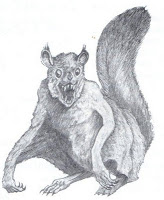
The Age of the Imperium is completed by a veritable horde of flora and fauna from across the galaxy all presented as GM controlled hazards and monsters. There are some real forgotten gems in here and whilst far too exhaustive a list to repeat here in full, some favourites include the Tyranid Slave organisms Zoats, Ambull Carnivorous Sand Clams (seriously) the infamous Catachan Devil, Genestealers (not associated with Tyranids at this stage and looking nothing like the genestealer we know) Spinethorns, Grox and Razorwings. Many of these exist in the 40k lexicon still, some, like the Ptera Squirrell were unfortunately fated to fade into obscurity.


From top to bottom: Sand Clam, The Pterasquirell and a Genestealer (really)


Book 4:

Book 4 is ‘The Advanced Gamer’ where some advanced optional rules and painting guides are imparted. Unlike these days there is a strong emphasis on improvisation and proxy. There are also rules for campaigns and an extensive plot generator effortlessly adding an incredible narrative and cinematic sense to the game. Its not all unending war adinifinatum, there is a real wealth of different settings and scenarios creating potential for some very interesting skirmishes that I would love to explore in greater detail at a later date. 

Which leaves just the summary and quick reference pages. Worthy of mention here are the Authors Notes, hidden nuggets offering even more information and detailing tech such as Electoos (which I had always assumed was a Dan Abnett creation and STCs. 

Overview:


Rules:

Warhammer 40,000 Rogue Trader can be comfortably labelled as a skirmish RPG, GM involvement is practically mandatory and the sheer amount of random generation charts and percentiles could be perceived as somewhat daunting, although the core rule mechanics are recognisable as what would become 2nd Edition 40k. It is obvious that grand mass battles are not the aim here and the standard would be no more than 30 models a side. At the Conclave we will soon be embarking on a series of games using the 40k ruleset so we can hopefully formulate a more informed opinion then. Suffice to say however that RT40k is loaded with enough off the wall character and special rules to ensure that with a decent GM battles will be an engaging and enjoyable affair effortlessly capturing the narrative and cinematic feel that GW strives so hard to artificially create these days. There is also a wealth of detail, making for an incredibly vital and visceral game setting. Even though there is much missing what is there is gritty and inmmersive if not ‘grimdark’ something which ruleswise has long been lost.


There are a LOT of these in the book


Artwork/Presentation:
The artwork in Rogue Trader is something of a mixed bag. The iconic front cover by John Sibbick (perhaps best known for his series of definitive dinosaur paintings) is an incredibly evocative piece depicting the Crimson Fists last stand against overwhelming Ork forces on Rynns world and was used by Grindcore Band Bolt Thrower for the cover of their album Realm of Chaos. The internal artwork varies greatly, from Will Rees superbly de0tailed crosshatched illustrations (heavily reminiscent of H.R.Gigers biomechanical stylings) to pictures that look like unfinished sketches by comparison and actually startlingly crude. One artist, Martin Mckenna is remarkably adept at faces and did the fantastic rogues gallery which appears at the end of the book. Some of the artwork looks like it could have been ripped straight from the pages from 2000AD from its black and white comic panel look and there is an early full colour John Blanche piece that has been reused many times hence. There are a few errors here and there that remind you this is an early effort from a fledgling gaming company, and incorrect header here, a repeated piece of artwork there, (even on the same page) However the art is functional and characterful even if it varies in technical competency as much as it does in style.


A couple of Reeses Pieces (Yeah i went there)

The rules are present throughout the book rather than being assigned one section and it does appear that the book is designed as a reference guide or sourcebook for GMs rather that something to be read cover to cover Difficult to judge by todays standards the presentation (diagrams and maps can be rather crude) it seems to be perfectly serviceable for its time, with some nice colour pages to show off the miniatures. 

There is a strong sense of 2000AD about much of the art. 


Background/Fluff:
More than anything else the thing that keeps me and I imagine a lotof others playing 40k, the background here is undeniably basic. Elements are here of greater things to come and it is obvious that this is the genesis of everything, but it’s more gritty than Grimdark and rather irreverent. Focussed firmly on the Imperium of Man, other races are paid a little attention and featured only in their most nascent stages. It almost seems the other factions are included only as antagonists for the human elements to fight as wandering monsters or the like, devoid of any real variation or real identity. Still, the Imperium is very well presented with all its various divisions featured in some way at least. The absence of Chaos is jarring, it really does feel as if something else is missing, the lack of a tangible nemesis for the Imperium making it feel like a much more sparsely populated galaxy. Obviously these and other races would be featured in time but for now their absence is keenly felt. 


I love this piece, theres a real zaniness and irreverence that has long since been lost. 

The weird and the wonderful permeate this book and although it would not go as far as to call it student like it does display a refreshing originality and informality that unfortunately was doomed to diminish with each successive iteration of the game. Space marines in particular are a very different concept to the version of the Astartes that we have today. But as I mentioned everything feels fery fresh and original. Not to say that there aren’t influences. It is obvious that a vast array of sources have inspired Priestly and co in the creation of this book, the universe itself being a heady mix of elements from Dune, Bladerunner, Alien, 2000AD and Mad Max, with even Star Trek and Star Wars hidden in the universes DNA in places. 

Summary:
Rogue Trader is a fascinating look at the embryonic state of the game and universe we all know and love today. In many ways I wish I had been involved in the hobby back in this time (I started in 2nd Ed around 1995) and would have loved to have been part of it and felt the excitement inherent in the inception of this new type of game. ]Packed with insights into the very genesis of 40k Rogue Trader is well worth a look for any hobbyist. Much of what lies within has been retconned out of existence but there is plenty which endures to this very day. Indeed when it comes to many of the aspects of the Imperium RT40k holds up as probably the most comprehensive source of information even now. More than anything else however, RT40k stands out as a labour of love. Soemthing put together out of a real desire to do something different (something Rick has been trying to recreate with his Gates of Antares project) as opposed to the mass miniature selling behemoth franchise that it is today. If you ever have the opportunity grab yourself a copy and indulge in the earliest days of 40k. And should you be fortunate enough to do so, keep an eye on Conclave of Har as we will be playing many more visits to this earliest of tomes in the near future. 

Al

Tuesday, 28 May 2013

It’s Grim in the Far Future, Much Like Birmingham - Origins of Rogue Trader 40k

It’s Grim in the Far Future, Much Like Birmingham


If like me the main influence on your hobby has been Games Workshop then you can’t help but harbour an inner fanboy that squeees in delight every time a new range is announced or a new edition or supplement crash lands on your table top.  While we may have issues with how management runs GW none of us can deny that the game developers give us that sweet hobby hit we all desire. 
 
My favourite range from Games Workshop is Warhammer 40,000.  40k is currently in its sixth edition and has been around in one form or another since the eighties.  Every large milestone White Dwarf may pay lip service to what went before but rarely do they go into any great detail about the past.  So here we are going to look at the beginnings of 40k and take a look at where it all began, Warhammer 40,000 Rogue Trader!

Origins

In 1986 there was an announcement in the pages of the Citadel Journal that Games Workshop were working on a science fiction tabletop battle game that was billed as an opportunity to create your own space opera full of all kinds of wild and weird characters and put them all kinds of outlandish situations be it hunting warp vampires or visiting a psycho circus!  It would be another year or so before the fruits of this labour were realised.

Rogue Trader was the genesis of the Warhammer 40,000 (WH40K) game and universe.  It laid the foundations of the Imperium of Man, warp space and the denizens that dwelled within and without its sprawling mass.  From this RPG led skirmish game erupted the behemoth that is WH40K today and it deserves some recognition.

When Eldar got their armour from the tribal tattoo planet.

When Rick Priestly joined Games Workshop he had already written a game called Rogue Trader.  Originally Rogue Trader was a spaceship and combat game set in a sprawling medieval realm precariously spread across warp space and populated by advanced humans, Ork raiders and space elf Eldar.  Rick had even designed a number space ship designs that later found their way into Space Fleet, a spaceship miniature game based in the WH40K universe.

Rick intended to develop the game as a pack in ‘freebie’ to be mailed out to Games Workshop customers who purchased their products.  This initial plan for Rogue Trader was put on hold as Games Workshop wanted the first game of this series to be set in a fantasy world.  Games Workshop had come about on the coat tails of the fantasy RPG boom of the 70s and 80s.  Back then they predominantly sold other companies products and White Dwarf was often filled with reviews and content for other company’s wares. 

This first ‘freebie’ game would eventually become Warhammer Fantasy Battle 1st edition (WHFB) written by Richard Halliwell, Bryan Hansell, Graham Eckel and Rick Priestly.  From a pack in game that went out with orders it morphed into a boxed game containing three booklets.  The popularity of WHFB meant that Rick went back and rethought Rogue Trader from the ground up.  It was rewritten to include the WHFB rule mechanisms and format.  This created a game that would be quick for players of WHFB to pick up and help to set a recognisable rule set that stretched across GW products.


This development was interrupted once more as other games demanded attention.  GW had won the license to 2000AD’s Judge Dredd which was released in 1982 which Rick contributed to as well as WHFB 2nd edition which was released in 1984.  In an effort to keep momentum on Rogue Trader going developments in the rule set of RT were folded into WHFB2E.  By this time Warhammer had developed a dark and dangerous background thanks to the miniature’s coming out of the studio and the accompanying art.  However, even after the completion of WHFB2E yet another distraction appeared in the form of Warhammer Fantasy Role-play.

  
Three guesses who this is.

By this point Rogue Trader existed in only two places, Rick’s head and an early computer printout.  GW had moved its development to the emerging technology of personal computers.  Rick decided this was an opportunity for another rewrite but even when this was completed there was to be one last hurdle to leap.


Games Workshop had acquired yet another license.  Coming from the same 2000AD stable as Judge Dredd, Rogue Trooper offered a brand distinction headache for Rogue Trader.  It was not a simple fix.  Simply calling the game Warhammer 40,000 wouldn’t do either as this was too similar to Warhammer Fantasy which in these early days of GW’s development was still cutting a niche for itself.  In the end the two likeliest candidates were merged and in September 1987 it was White Dwarf #93 that heralded the release of Rogue Trader Warhammer 40,000 (RT).   This was a bit of a mouthful so ended up being shortened to the familiar ‘WH40K’, ‘0-kay’ or occasionally ‘warty thou’.  This is a tradition that exists to this day. 

Development

There were a number of game play mechanisms that could not simply be ported over from the fantasy rules and which required new mechanisms all of their own.  These mechanisms have stood the test of time.

The first problem was with movement.  In WHFB movement was strictly controlled and was far more convoluted than it is now.  Units were formed up into base contact and where one model went they all went.  This would not do for RT where models would be moving freely in loose skirmish formations.  The answer was coherency rules.  Models could move freely up to their own movement value but would have to stay within two inches of each other with detrimental effects applied for any models that strayed outside this range.

The second was the idea of true scale which was confusing weapon ranges.  Real life weapon ranges were far too long to allow any kind of tactical difference between weapons.  Most guns’ true ranges meant they would all have a chance to hit enemies from a board length away.  A decision was made to use abstract ranges so that on the tabletop there was a clear delineation between different weapon types. 

The only problem with using abstract ranges was with vehicle models.  Depending on the size of the vehicle it was entirely possible that a pistol shot may not be able to hit a model a vehicle length away.  Originally Games Workshop did not intend on making any plastic vehicle kits so this problem was accepted as nobody really expected vehicles to see much use and Rick was not in favour of seeing them on the tabletop either.  Rick Priestly reiterated his stance on vehicles again recently during interviews for the Beyond the Gates of Antares Kickstarter.


Not shown ‘Suck it knob head’ artificer embellishment picked out in gold leaf.

The third problem was with representing large or unusual rates of fire.  This led to the development of templates.  Though common now this was a new idea for its time.  In the beginning any weapon that fired more than one shot such as rapid fire, exploded on contact such as a missile or which laid down a spray of liquid such as a flamer used a template.  A template would be placed where the shots were deemed to land after any deviation and hit models beneath it.  Rick had to sell the idea pretty hard though he maintained that it fit into one of his important game design principles, a game rule must not only reflect what happens but the way in which it happens.  Eventually a compromise brought about the idea of ‘following fire’ where a weapon continues to role for damage against models in the same unit until it fails to wound.  Not a mechanism that would see wide use in future editions.

The final new mechanic was the idea of weapon strength.  RT used the same method of checking attack strength against a target’s toughness characteristic with a modifier to the model’s save linked directly to the strength of that attack.  In a futuristic world where even the simplest weapon may contain enough power to kill a man or even leave nought but a pair of smoking boots a rethink was needed.  The result was the link between strength and saving throw to be severed and instead the modifier would be dependant on the weapon type instead.  Along with this was the introduction of variable damage.  This meant that while two different weapons may have similar strength their ability to cut through armour and the damage they would do if the target failed to save would differentiate them.

From there it was necessary to introduce rules for vehicles which would not be found in WHFB.  Even though it was not envisioned that vehicles would be a huge part of game play they still required rules should the player wish to use them.  These original rules were not very different from those governing regular infantry with only movement being significantly changed.  In fact the familiar armour value system of today was not present at all with vehicles more closely resembling monstrous creatures with high toughness and multiple wounds with a critical hits system to represent systems damage.  There were even rules for flyers!

The last thing to resolve was equipment.  At the time (and even as now) rules were written to accommodate models.  Rick wanted to stop the possibility of having to release new rules for every crazy creation that would find its way out of the studio so decided on standardised equipment.  Therefore every Space Marine had a bolter and the threat of ten individually armed models all requiring their own special rules and considerations were averted.


This kind of thing was entirely normal

Tone and Influence

Compared to today’s ‘grim-dark’ and dystopian vision of the far future Rogue Trader was somewhat irreverent.  Inspiration was drawn from Sci-fi writers and television programs  from all over the 70s and 80s such as Harry Harrison, Larry Niven, Jerry Pournelle, Star Trek, UFO, Philip Jose Farmer, Doctor Who, Blake’s 7, Space 1999, Frank Herbert, Michael Moorcock, Arthur C Clarke & Philip K Dick.  The irreverent attitude from the stories and characters of 2000AD also had a large influence especially considering that Games Workshop had its own Judge Dredd game during RT’s development.  A lot of the artists from 2000AD contributed to the artwork in the book and the GW team worked closely with some of their writers.  Both groups would even meet up at the local watering hole the Salutation Inn.

Looking inside the book there are many examples of a tongue in cheek sense of humour running through the visions of the far flung future.  Space Marines with humorously offensive messages etched on their armour, cigar smoking pot bellied anti-grav surfing squats, Orks in general, giant space wasps and killer squirrels!  


Some of this irrelevance has even survived to this day lest we forget the Black Planet of Birmingham which gets no light from its sun meaning it receives few visitors and as a result has become linguistically and culturally isolated.  Currently Birmingham is uninhabited the population having been taken by Dark Eldar raiders and since becoming the site of a daemonic incursion.

One of the greatest heroes of the 41st millennium owes his origins to such light hearted humour.  Pedro Kanto the current chapter master of the Crimson fists was a named character used in the very first RT battle scenario ‘Battle at the Farm’.  His oversight of the greatest tragedy to hit his chapter was not as it is now born from a million to one chance misfortune but can be blamed wholly on his incompetence.  His inspiration came from Pete ‘Pedro’ Cantor a friend of Rick’s whose less than successful gaming exploits earned him immortalisation within RT.

Despite this the brutal and bloody violence of this future is evident in the artwork.  Space Marines are blown apart, shot and burned in many different and grisly ways.  Severed heads sit alongside hideous mutants and beneath it all the oppressive and overbearing authority of the Imperium is ever present.

Background and Rules Development

The background section for Rogue Trader includes a great many concepts which are staples of today’s lore.  The Emperor and the Imperium are present as well as warp space and psykers.  Space Marines are there though the idea of primarchs and the Horus Heresy would come later and be woven into the proto-epic game Adeptus Titanicus.

Orks and Eldar were at that time alien pirates and raiders.  Orks and Gretchin were represented though without a lot of the flavour and additional troop types that are common today.  Eldar did live on craftworlds but were more akin to corsairs.  The Tyranids even appeared though the only unit that was included or even had a model was the Hunter-killer which today would be recognisable as the lowly Termagaunt.

Races which are no longer to be easily found within the Warhammer 40,000 universe include the Slaan, Squats and Zoats.  Slaan have found a home within Warhammer fantasy as servants to the star spanning old ones who are now a connecting thread between GW’s main franchises.  The Squats continue to be popular and controversial amongst the fandom.  Space Dwarves are cool but because GW could not find a way to make Squats anything other than futuristic versions of their fantasy counterparts they were quietly dropped from the lore during second edition.  Zoats were a slave race of the Tyranids back when the idea of the Hive Mind was not fully formed.  They exist today as an enigma that appears every now and then.  Look for them in the current sixth edition rulebook in the xeno section.


Nothing to see here, move along.  No sir I do not know who or what a Demiurg is.

Then there are some parts of RT that made it in because there was an existing miniature that could easily represent something else.  Jokaro exist because GW produced an orangutan model, Dave the mayor of Mega City 1!

The original intention was that players would convert their own miniatures from fantasy figures available at the time.  This was one of the reasons that fantasy archetypes find prominence in the Warhammer 40,000 universe with Orks (Orcs) and Eldar (Elves) as major races.  Despite this there was a need to populate the universe with models that represented the units that could not easily be represented or to act as a guide to the aesthetic that was relevant to each of those races. 

As the game increased in popularity the studio began to develop and release more models.  With the release of Slaves to Darkness and The Lost and the Damned came Daemons and Space Marine Renegades.  Craftworld Eldar, Squats and Genestealer cults appeared as White Dwarf army lists Tweaks to rules for Space Marines and vehicles would also appear leading to the vehicle data fax that introduced armour values.  Imperial Guard infantry appeared during this time while Orks received both a background book in ‘Waaargh the Orks!’ and what was effectively the first codex with ‘Freebooterz’.

Rogue Trader started as a games master led skirmish RPG.  As the popularity of RPGs waned the role of games master was phased out with games being played between two players alone who would manage their own game.  Not until Inquisitor appeared would Games Workshop reintroduce the role of the games master.

Eventually rules development would lead to the release of the ‘Warhammer 40,000 Battle Manual’ which was the prototype for Warhammer 40,000 second edition and would lead to the massed battle game that it has become now. 


                                                                           Uncanny!

Legacy 

Today Warhammer 40,000 is a recognisable piece of science fiction and wargaming culture.  The universe germinated in Warhammer 40,000 Rogue Trader has exploded in scope and there are hundreds of books, numerous comic, video games and even one short film that expands upon the stories that are being told on the tabletop. 

Background wise we see a lot of ideas that have not seen much exposure since the RT era coming back into fashion.  Look in the sixth edition rulebook and you will find once more mention of Squats.  There is a picture of a Zoat and an Ambull in the xeno section.  Jokero accompany Inquisitors and graviton guns are being wielded by Techmarines on battlefields across the country.  At Forge World RT designs are reborn in the shape of miniatures for the Horus Heresy while Eldar Cosairs strike from the pages of The Doom of Mymeara.

Though the WH40K of today is a vastly different beast from the narrative led RPG skirmish game it began as its basic rules mechanics are still present.  Psi points, the fantasy hand to hand combat system and flyers are not new ideas but throw backs to RT.  In White Dwarf 400 Jervis writes part one of a two part look at adding a games master to your games reminiscent of the narrative led play of RT.  Is this time to revisit those early years?  I certainly think so if only to learn what else we can import to our modern games to enhance our hobby experience.

Lee

Sources:  Warhammer 40,000 Rogue Trader (obviously) WD #94 & #95 'Tales From The Maelstrom blog interview with Rick Priestly'.